[Issue# 007] The Shade I Will Never Sit In
Hey, it's Mark.
A black walnut seedling costs about sixty-four cents and looks exactly like a stick somebody shoved into the dirt.
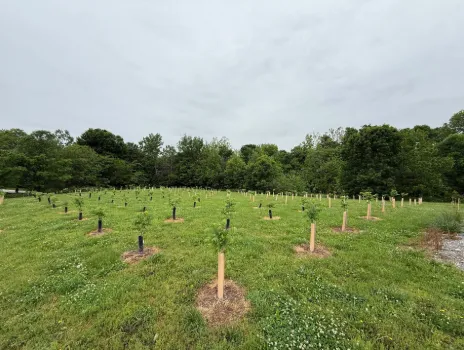
In the spring of 2025, I put 550 of them in a field that I can see from my house. I wanted to be able to look at them every single day.

I am fifty-five years old.
What I actually signed up for.
I will get to watch them grow. I have already started pruning them. If I am lucky and stubborn, I might sit in a little of their shade someday, when I am old and they are barely getting started.
But the shade those trees will throw when they are grown… that shade is not for me.
My grandchildren might sit in it. My great-grandchildren almost certainly will. Somebody will walk through that grove long after anybody remembers the man who put the sticks in the ground.
You can do that math as fast as I can.
Here is the surprising part: Knowing that does not make it feel like less of a good idea.
It makes it feel like more of a REALLY good one.
Maybe you already know that feeling. Maybe there is someone you have poured into for years… a son, a daughter, a young leader on your team… and you still do not know if any of it took.
This letter is for you.
What are you measuring by?
We tend to measure our influence by what we can see.
Did they listen? Did they change? Did they take my advice? Did they ever say thank you?
It is not hard to see why.
At the same time, the people who planted the deepest things in many of us are getting older, or they are already gone. And a lot of the leaders I sit with are asking a question they did not used to ask… who comes after me?
When everything around you is measured in seconds, it is easy to decide that what you cannot see does not count.
I think that is the wrong measurement.
My job is not to receive the harvest. My job is to plant the trees.
Planting is the easy part.

Anybody can put a stick in the ground. That took an afternoon. What comes after is the whole thing.
Lets get candid . I keep saying "I planted them," which is how people talk and is not really true. It was my idea, the responsibility is mine, and I am the one who will still be out there in twenty years. But nobody puts 550 trees in the ground by himself, and nobody gets them through the first summer alone. There were people in that field with me that spring and all the way through that first year, when those trees needed more than they have needed since.
We put plastic sleeves on every one of them so the deer would not rub them to death. That first summer was dry, and somebody was out there hauling water, over and over, because a two-foot tree has nowhere to go for water and no time to wait on rain.
And I prune them.
That part changed how I think about people.
Here is what almost nobody knows about a walnut tree.
The value of a walnut tree is not in the branches. It is in the length of straight, clear trunk before the first branch. That is what a mill pays for. The longer the run of unbroken wood, the more the tree is worth. And whether a tree ends up ordinary or exceptional comes down, in large part, to whether somebody took the low limbs off while it was young.
So you walk out to a tree barely taller than you are, and you cut off the branches it is trying to grow.
There are rules about it. You do it early, while the branch is still an inch or two thick, because if you wait, the wound never closes clean and the flaw is in there forever. You never take more than about a third of the living crown at once, or you will hurt the tree you are trying to strengthen. And you keep at it, a little at a time, for years.
The most valuable part of the tree is the part with nothing growing out of it.
I don’t think I have to explain what that is a picture of.
Cut it early, while it is small enough to heal. Never take too much at once. Keep showing up. And understand that all that careful subtraction is building a strength you will not be able to measure for decades.
Then there is the number that is mind blowing:
Fewer than 1% !!!
It is not the planting that makes a walnut tree valuable. Anyone can plant.
It is the fifty years of somebody being close enough, often enough, to notice what it needs.
Even done right, most of the trees you plant are not the ones you harvest. You thin, year after year, until only a few per acre are left. You do not get to know which ones. You tend to all of them and let time sort it out.
Proximity is not the moment you plant. Proximity is the fifty years of staying close enough to matter.
NOT possible to control
Everything I have told you about this process so far, happens above the ground. The sleeves, the water, the pruning, walking the rows. All of it visible. All of it ours to do.
None of it makes a tree grow.
I have never made a single root grow. I cannot get down there. Whatever is going on under that field is happening in the dark, on a timetable I did not set… and the roots are what decide whether those trees are standing in a hundred years. They are also the only part I will never see.
I am a man faith, and this is the piece of it I understand best. You can hand somebody a seed. You can put it in good ground, keep the weeds off it, come back day after day. What you cannot do, with all the effort in the world, is reach down and make it take hold. Somebody else does the inside work.
I believe that part is God's. You may see it differently, and this letter still works… because I have never met anybody who put something in the ground and believed they were the one making it come up.
People are exactly the same, and that is the part that humbles me. You can be present. You can tell the truth. You can show up for twenty years. You cannot reach inside another human being and make anything take root.
Which is why the things that matter most get caught, not taught.
The conversation ( hear me out )

Recently, I had to make a trip to Utah, and my son Markus jumped on the plane and came with me. He ended up out front at the Utah State event, working a crowd of total strangers for a cause were supporting. That is exactly the kind of thing he is good at now.
Later, at a table, somebody asked him, "You said you were a shy kid. How did you turn into this?"
I did not say a word. I just sat there.
Markus said:
I sat in that chair and felt the floor move a little.
Because that is my sentence. That is exactly how I have run my life since I was younger than he is. Go at the thing that scares you, head on, immediately. I never wrote it on a wall. I never made him memorize it. I am not sure I have ever said it to him in those words.
He caught it. Somewhere in twenty-some years of being close to me, he picked it up, and now it is not a lesson he remembers. It is just part of how he is built.
Nobody plants generosity with a lecture about generosity. You plant presence by putting the phone down and looking at the person next to you, over and over, for years, until they think that is simply what people do.
Here is the hard part :
Recognizing those who planted
I was talking with someone about who shaped me. REALLY shaped me.
The answer came super fast. It was my grandfathers… and of course my father, Larry. (Hi Dad!!!) I will write about Larry in a separate issue.
Grandpa Bob. Grandpa Wade. And my great-grandfather, Grandpa Charlie.
Some of you met Charlie and Bob in my last letter. Charlie is the one who told a man he loved to go pack his bags, and Bob is the man who said YES it to.
Charlie was a farmer with an eighth-grade education.
He has been gone more than thirty years. And I am sitting here at fifty-five, finally old enough to understand what he put in me, harvesting things…that man planted half a century ago.
He never saw any of it. Not one bit.

Charlie planted a tree whose shade he was never going to sit in. I just did the same thing with a shovel.
Someone planted in you, too. Chances are they never saw the harvest either.
Part of honoring them is noticing that...and the other part of it is picking up the shovel yourself.
How this reflects professionally..
This is not only a family thing.
Years ago, I hired a young man before he was out of college. I made him a deal.
He did it, and he was instrumental in that company. Then he came to me with a business idea and offered me a piece of it.
I told him no. That was not our deal. Our deal was five years, and then I back you.
So I backed him. He and another young man, I had hired out of college, started that company together, and within a few years it was bigger than mine. More profitable. More successful than the business he had learned in. I ended up investing in it, and years later, we sold it.
There is not one ounce of jealousy in that story, and there never was.
I have spent more than three decades building companies, and this is the part I see leaders get backwards. We develop people just far enough to stay useful to us. Then we wonder why the tree never grows taller than the fence.
He passed me. By a leap.

A point will come out in that field when those trees stop needing me. The roots will be deep enough that a dry summer is just weather. The pruning will be finished, because the branches will be forty feet over my head, where I cannot reach them and do not need to.
It is the same with a kid, the same with a business you hand off, the same with anybody you have poured into. Every parent I know dreads that day a little.
I think we have it backwards.
So look at the people you are pouring into right now. Are you tending to them so they can stay close to you… or so they can outgrow you?
Final question.
Someday, long after I am gone, I hope one of my great-grandchildren walks through those trees.
They will not know me. A name, maybe a photograph. But I hope somebody there says, "Your great-grandfather planted these. They were nothing but sticks in the ground."
And maybe that kid stops and wonders why a man would do that.
I know why.
I think that is what we are doing every time we get close to somebody. Every knock at the wrong hour that we answer. Every trip we did not have time to take. Every ten minutes pushing a little girl on a swing.
We are planting. We just cannot see it yet.
So here is my question for you:
Who are you planting in right now?
Somebody is getting your time, your attention, and your example, and they have no idea it is happening. A kid. A young employee. Somebody who called you at an hour nobody should call.
You will probably never see what it becomes. Tell me who they are anyway.
Hit reply with their name and one sentence about what you are trying to put in them. I read every single one, and these are the ones I most want to read.
It is good to be back.
Mark.